Stand and Be Counted Theatre Company
The Interview
Stand and Be Counted Theatre Company
Stand and Be Counted Theatre Company is one of sanctuary, that approaches society’s matters through the foundation of their performance work within the UK and internationally. They encourage social and political change for people who have suffered from many encounters, through their use of art. Hannah Butterfield, Rosie MacPherson and John Tomlinson cooperate to create, write and produce the work.
One of their performances, ‘Where we began’ is a chronicle for immigration through the use of music, text and dance. Shireen Farkhoy, Zoe Katsilerou, Fernanda Mandagara and Tafadzwa Muchenje are all performers within this work that explain their autobiographical narrative for the difficulties of being an immigrant. There is a requirement for the type of performance work that targets real life stories and using them in a different way, as there is the view that socially, we turn a blind eye to these issues. Personally, I interviewed theatre-maker Hannah Butterfield to delve into her philosophy for why SBC created ‘Where we began’.
Hannah Butterfield interview – 16.12.19
Interviewer – Jacie Matts
Hannah – Hannah Butterfield
Interviewer: What was it that brought you to work with the idea of immigrants?
Hannah: Well, specifically for ‘Where we began’, it was born out of an audience response to ‘Tanja’ which was the first piece of work that we’d toured together. It was a campaign piece of theatre about trying to end detention for vulnerable asylum seekers in immigration detention centres. Then, when we were performing the work at Camden People’s Theatre in London, we did a weeklong run there and one of the people in the audience was a young man called Tafadzwa Muchenje. He had just received a deportation letter. The performance spoke to him on a personal and political level, so he wanted to talk to us after the performance about how we made it and what had led us to that point and from that conversation, he told us about his personal experiences.
Interviewer: How would you characterize the relationship between your own visual thoughts and the thoughts of your actors?
Hannah: We did an open call to find people who were performers from different backgrounds with different kinds of experiences, from different disciplines. But, the thing that connected all of them was that, there were concerns about migration and about the changing laws around that and perhaps about Brexit. So, the open call was really to try and find collaborators who already had an interest and personal experience of some of the key themes that we wanted to address. The first person that we cast was Tafadzwa. We put together a team of people and spent three or four weeks in Doncaster living together, working long days, just exploring. I would run a workshop activity, where the tasks were set up by me, but the response was all theirs.
Interviewer: Is it important that the spectator is aware of the context of the performance?
Hannah: A large number of people who came to see that piece of work had seen ‘Tanja’ and were coming to see this as the second piece. So, in that respect it’s the kind of work that attracts people who are already interested in some of the issues largely, it’s important to recognise that were speaking to people who already have some kind of interest or knowledge or feelings about some of these themes. But, we really wanted to make it accessible enough that anyone who came to see it could be part of that conversation. We also wanted to target community groups particularly sanctuary seekers, because that’s part of our commitment as a theatre company.
Interviewer: Did the ethics of the work bring difficulty?
Hannah: Yes definitely, all of the time. When you’re working with people’s personal experience, there are loads of challenges that come up with that. All we could do really was just work with respect and compassion for the people that we were working with, also try not to make it a club and try to spend as much time as possible devising workshops as a group.
Interviewer: What engages you to work with people with real stories?
Hannah: Part of it is about getting sick and tired of seeing work that is sort of addressing these issues, but the people who are directly affected by some of these things, aren’t present. Or if they are present, it’s been constructed before they became involved. It’s born out of frustration with some of the work that we’ve seen and wanting to try a different way of doing it. We want it to be responsive to the immediate group of people working on that project.
Interviewer: What are the underlying politics in where we began, is there a Politics of place?
Hannah: Yes definitely, all of the first explorations were about what is home to different people and that’s where we began. Then, some political advisors came in so, Trevor McFarlane who was MEP at the time came in to talk to us about some of the policies and changes in policy since we’d made ‘Tanja’, so that was really interesting for us. Also, talking about people’s experiences of living in different places and that their connection to work as well, is a really important starting point. The fictional scenario of being set in some kind of future dystopian world where everybody has to go and live in a country that they’re born in was used as a tool. It becomes more outward facing, so it’s not just about the people who are there, because the people are real, but they’re in a fictional situation, so hopefully that opened up opportunities to talk about some of the big political issues because of the fictional frame.
Interviewer: Do you feel as though there’s an expectation to make a change with a performance like this?
Hannah: Yes absolutely, we are really aware that the kind of people that we make work for is seen by people who are already interested in and agree with some of the particular political perspectives. As much as there is ambition to tackle some of these issues and approach MPs, equally we are aware of the context in which we present work. As theatre makers, we’re doing what we can to add to the conversation about key political issues and specifically changes we’d like to see happen.
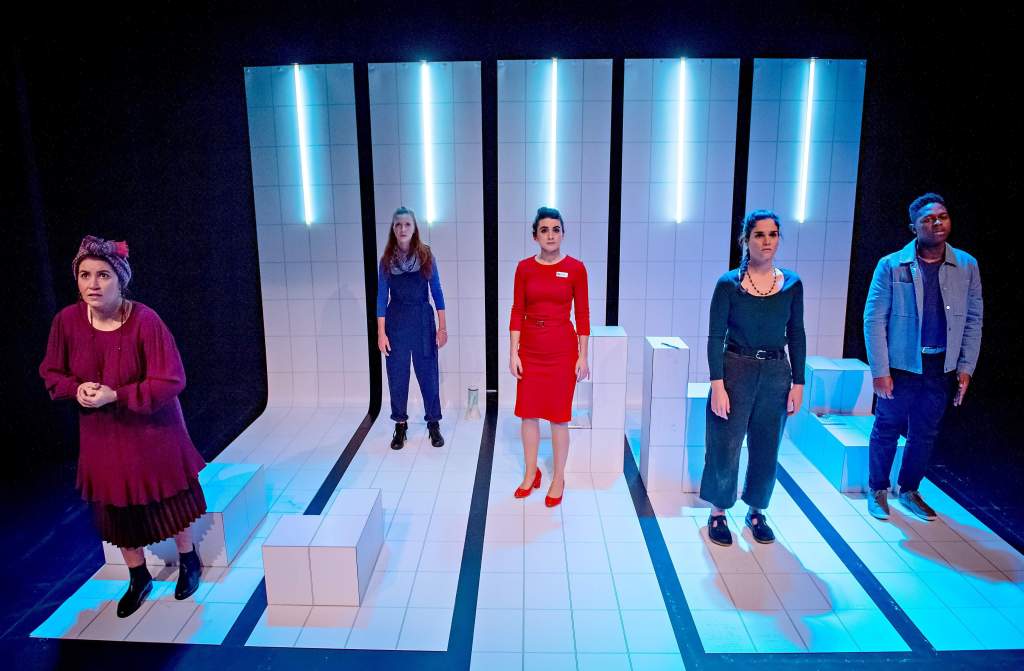
A short review
Unquestionably, Muchenje and his queries about the work of ‘Tanja’ was the result of how ‘Where we began’ initiated and the subject of migration. Interestingly, SBC involve the direct lives of migrants who face injustice and their stories to their performance, as a result of this not being regular in the world of theatre. The work gives an insight of what point the world could reach and how it could end up.
The pertinence of this kind of work, allows audience members to ally with the message put across and be genuine. Also, the authenticity of the performance provides an opportunity for real emotion to be evoked. The work matters due to the conversation that is to be spoken about after, there is a change being enforced by this type of work, politically and socially. Unlike a lot of performances, ‘Where we began’ induces legal modification for the inequality truths that the UK owns.
 Socially Engaged Arts Practice: Collaborative Encounters and Conversations